Object Lesson. 2006.
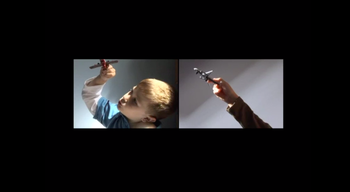
Object Lesson considers the fine line drawn between personality and diagnosis. In this piece, a young boy plays with the objects that fascinate him. When the voice of a medical doctor begins to narrate, the child's play is called into question. The child ultimately becomes an object under the interest of medical authority.
This piece also alludes to a childhood diagnosis of Asperger's Syndrome. As the objectification of the child increases under the scrutiny of the doctor, the child's image is reduced to body parts. These body parts are eventually displayed in sync with accompanying images of objects. This refers to the diagnosis of Asperger's Syndrome itself which is commonly associated with an intense interest in objects (particularly mechanized objects). The sync-up of the images in time to the sound of a record skipping also refers to the diagnosis; people with Asperger's syndrome often prefer routine and repetition.
Object Lesson illuminates some of the traits of Asperger's Syndrome while pondering the supposed abnormalities of such traits. This piece considers normalcy versus disorder particularly in relationship to child's play. In that vein, it also considers the value or setbacks of conformity. Below is an excerpt.
This piece also alludes to a childhood diagnosis of Asperger's Syndrome. As the objectification of the child increases under the scrutiny of the doctor, the child's image is reduced to body parts. These body parts are eventually displayed in sync with accompanying images of objects. This refers to the diagnosis of Asperger's Syndrome itself which is commonly associated with an intense interest in objects (particularly mechanized objects). The sync-up of the images in time to the sound of a record skipping also refers to the diagnosis; people with Asperger's syndrome often prefer routine and repetition.
Object Lesson illuminates some of the traits of Asperger's Syndrome while pondering the supposed abnormalities of such traits. This piece considers normalcy versus disorder particularly in relationship to child's play. In that vein, it also considers the value or setbacks of conformity. Below is an excerpt.